Comfort-First Dentistry · Richmond Dental Spa
Laser-Assisted Cavity Preparation
A gentler way to treat a cavity — Fotona Er:YAG laser technology, often paired with photobiomodulation, designed around Dr. Albadran’s philosophy: avoid unnecessary discomfort at every step.
Clinical Authority
Why Dr. Albadran Uses Laser for Cavity Preparation
Traditional drilling relies on friction, vibration, and heat — all of which contribute to the discomfort patients associate with “getting a cavity filled.” The Fotona Er:YAG laser works differently: its wavelength is absorbed almost entirely by water in the tooth, allowing it to gently ablate decayed tissue with minimal heat, no vibration, and no drill noise.
Dr. Albadran holds the ALD Dental Laser Standard Level certification from the Academy of Laser Dentistry, and has built much of his comfort-first, biological approach to restorative care around this technology.
Dental Laser Standard Level — 2023
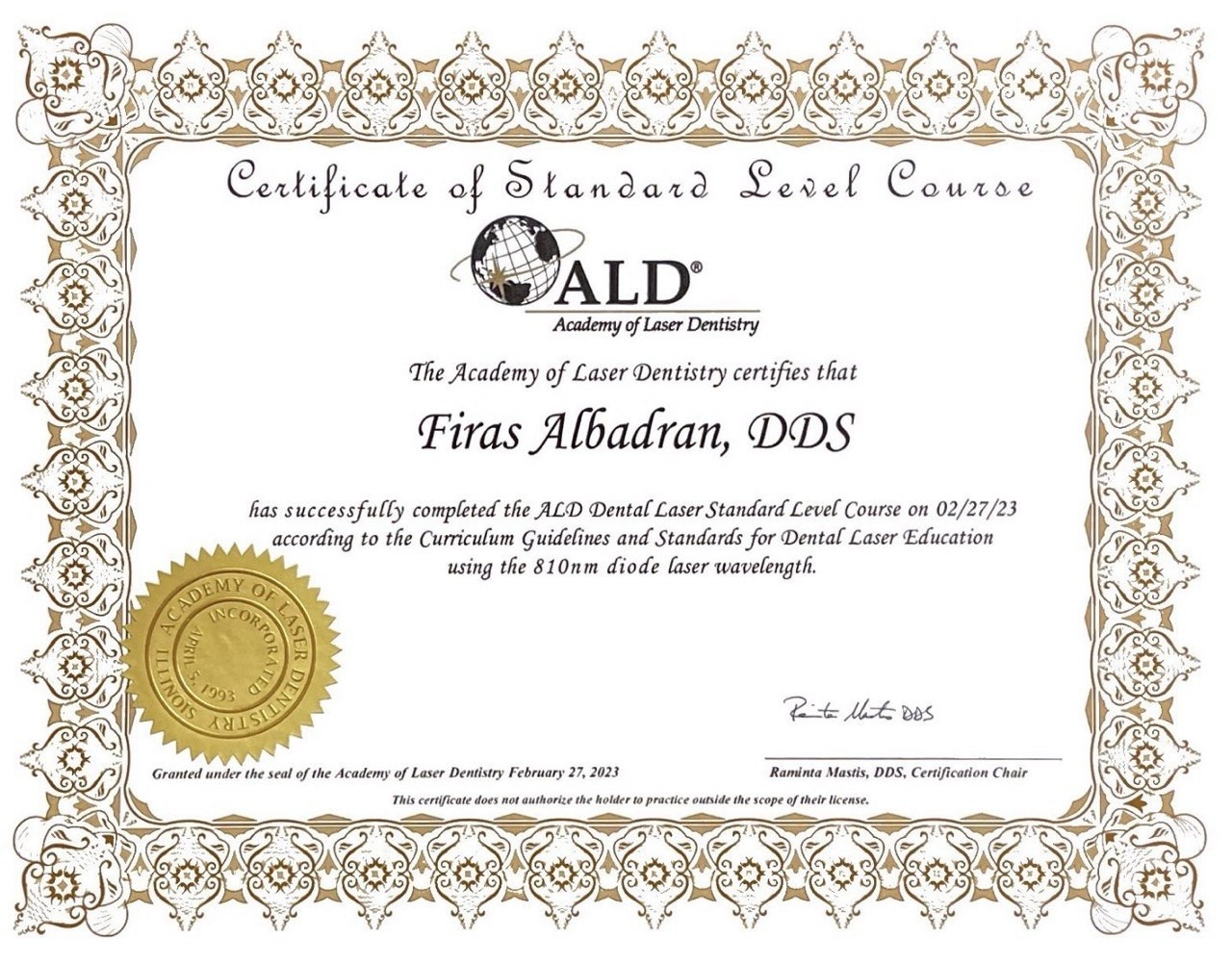
Dr. A — ALD Dental Laser Standard Level Certification · 2023
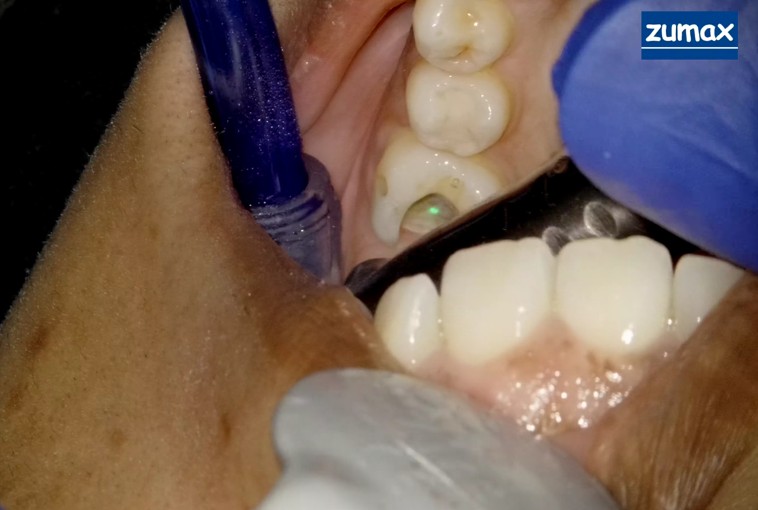
Laser cavity preparation — quiet, vibration-free treatment of decayed tooth structure.
About the Treatment
What Is Laser-Assisted Cavity Preparation?
The Fotona Er:YAG laser (2940 nm wavelength) is FDA-cleared to remove decay, shape the cavity, and prepare enamel and dentin for a filling — the same core steps a traditional drill performs, done instead with focused laser energy.
Because the wavelength is so strongly absorbed by water in the tooth, the laser selectively targets decayed, water-rich tissue while leaving healthy structure largely undisturbed — a more conservative, minimally invasive approach to treating a cavity.
Why it’s often more comfortable: No drill vibration, no friction-generated heat, and no mechanical noise — the three things patients most associate with dental anxiety. Many patients report the sensation as more of a light tapping or tingling than the pressure of a traditional drill.
The Comfort-First Protocol
Two Steps Before Every Cavity Is Prepared
For many patients, Dr. Albadran combines two technologies — in sequence — before restoring the tooth.
Photobiomodulation (PBM)
A brief, painless low-level laser application calms nerve sensitivity in the treatment area before any cavity work begins.
Er:YAG Laser Preparation
The cavity is gently prepared with the laser — quiet, vibration-free, and precisely targeted to decayed tissue only.
An Honest Comparison
Conventional Prep vs. Laser-Assisted Prep
This is a genuinely different appointment — not a drop-in replacement for a standard filling. Here’s how the two approaches actually compare.
| Feature | Conventional (Drill) | Laser-Assisted (PBM + Er:YAG) |
|---|---|---|
| Chair time | Typically shorter — single stage | Longer — two stages (PBM, then laser prep) |
| Anesthesia | Usually an injectable local anesthetic | Often topical only, for many patients — injectable anesthesia remains available when needed |
| Sound & sensation | Drill vibration, pressure, noise | Quiet, vibration-free; light tapping or tingling sensation |
| The filling/restoration itself | ✓ Covered by most dental insurance | ✓ Covered the same way — same restorative procedure code |
| Photobiomodulation (PBM) step | Not applicable | Additional fee — typically not reimbursed by dental insurance |
Backed by Clinical Research & FDA Clearance
The Er:YAG laser has been FDA-cleared since 2002 to remove all classes of dental caries, form cavity preparations, and modify enamel and dentin prior to bonding — the same core steps as conventional drilling, using a different energy source.
A 2025 meta-analysis of randomized clinical trials (ScienceDirect) comparing laser to conventional bur preparation found that laser-based cavity preparation provided a reduced need for anesthesia and lower pain perception compared to traditional rotary instruments, with no significant difference in restoration survival or pulp vitality.[1]
A continuing-education review for dental professionals notes that experienced Er:YAG laser practitioners report needing injectable anesthesia in only 10–20% of cases — typically reserved for larger lesions, amalgam removal, or unusually sensitive teeth.[2]
On the photobiomodulation side, a published pilot study specifically examined PBM’s effect on anesthesia acceptance during cavity preparation, and a 2022 systematic review found a positive analgesic effect in four of five included studies — while noting the overall evidence base is still developing and would benefit from larger, more rigorous trials.[3]
Dr. Albadran discusses this evidence directly with you at your consultation, including what to realistically expect for your specific tooth and sensitivity level.
Watch: the two-step comfort-first protocol in action — PBM, then Er:YAG laser cavity preparation
The Evaluation
How Dr. Albadran Decides If Laser Prep Is Right for Your Tooth
Not every cavity is a candidate for laser-only treatment. Before recommending this approach, Dr. Albadran evaluates the depth, location, and size of the decay, along with your individual sensitivity and anxiety level.
- Caries depth & location — surface and moderate decay respond best; very deep or large lesions may still benefit from traditional anesthesia
- Tooth sensitivity history — informs whether PBM alone, topical numbing, or standard anesthesia is the right starting point
- Anxiety & needle sensitivity — for patients who dread the injection more than the procedure, this protocol is often the most comfortable path
- Restoration plan — laser-prepared surfaces are compatible with standard bonded fillings, inlays, and onlays
What to Expect
Your Treatment, Step by Step
Evaluation
Dr. Albadran examines the cavity, reviews your history, and determines whether laser-assisted preparation is the right fit for this tooth.
Photobiomodulation (PBM)
A brief, painless laser application to the area to calm nerve sensitivity before treatment begins.
Laser Cavity Preparation
The Er:YAG laser gently removes decay and shapes the cavity — quiet, vibration-free, no drill noise.
Restoration
The tooth is restored the same visit with a bonded filling, inlay, or onlay — same-day, in most cases.
Is This for You?
Who Benefits Most From Laser Cavity Preparation
Complementary Treatments
Part of Dr. Albadran’s Biological Restorative Approach
Laser cavity preparation pairs naturally with the other conservative, tooth-preserving techniques used throughout Richmond Dental Spa.
Deep Margin Elevation
For decay that extends below the gumline, Dr. Albadran’s microscope-level DME technique can often save a tooth that would otherwise need extraction.
Biomimetic Dentistry
Once the cavity is prepared, biomimetic restoration techniques preserve as much natural tooth structure as possible — partial crowns instead of full crowns whenever clinically possible.
Insurance Coverage: The filling or restoration itself is billed and covered by insurance the same way whether it’s prepared with a laser or a drill. The photobiomodulation (PBM) step that makes the laser-assisted protocol more comfortable is billed separately and is typically not covered — see the comparison above for details. Our team verifies your benefits and confirms all costs before treatment begins — no surprises.
Research Sources
sciencedirect.com/science/article/pii/S0300571225001423
dentalcare.com/en-us/ce-courses/ce394/restorative-dentistry
link.springer.com/article/10.1007/s10103-022-03590-4
nedelta.com/providers/resources/cdt-code-and-policy-changes/
A Gentler Way to Treat a Cavity
Start with a question, or schedule directly — Dr. A’s team responds the same day.
Request a Consultation
Tell us about your cavity, your concerns, or your comfort needs. Dr. A’s team will reach out personally — same day.
Book Online
Skip the form — pick a date and time directly in our scheduling portal.
Book Appointment →
Serving Richmond, Short Pump, Henrico County, Glen Allen & surrounding areas
📍 Get Directions →
Richmond Dental Spa · 9305 Quioccasin Rd, Suite A, Richmond, VA 23229 · richmonddentalspa.com
This page is for patient education purposes only and does not constitute medical advice. Individual results and comfort levels vary by tooth and by patient. A comprehensive clinical evaluation by Dr. Albadran is required to determine whether laser-assisted cavity preparation is appropriate for your specific case. Insurance coverage varies by plan and is not guaranteed.